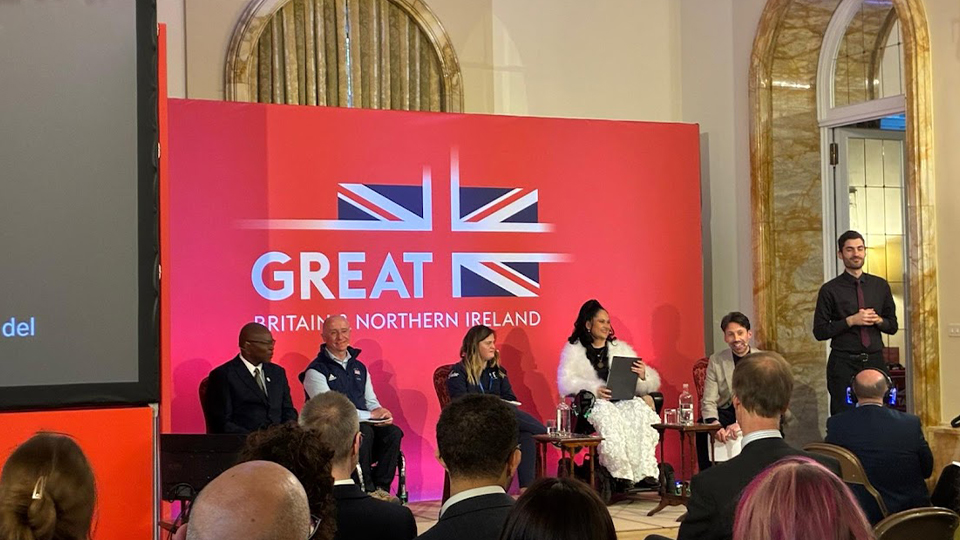
Hosted at the British Ambassador’s Residence, the event marked the close of the Winter Paralympics and focused on how Paralympic legacy can drive wider systems change. The convening formed part of the AT2030 programme led by the Global Disability Innovation Hub (GDI Hub), of which Loughborough University London is a founding partner. The event was attended by senior government representatives, including Rt Hon Sir Stephen Timms MP, UK Minister for Social Security and Disability, and Hon. Alessandra Locatelli, Italian Minister for Disabilities.
From visibility to participation
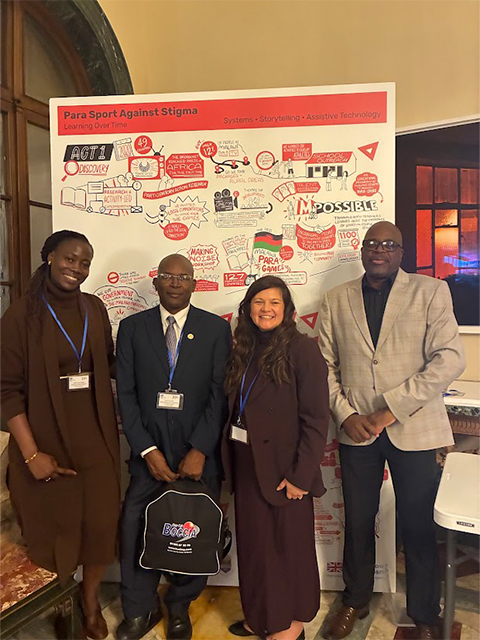
At the centre of Loughborough’s contribution was the Para Sport Against Stigma (PSAS) programme—an applied research collaboration delivered through AT2030. The programme brings together research, storytelling, and system-level interventions to explore how sport, media, and assistive technology intersect to shape participation.
Over six years, the work has built a growing evidence base across Sub-Saharan Africa, showing that visibility alone is not enough. While broadcasting and storytelling can shift perceptions, participation depends on the systems around them—access to assistive technology, local pathways, and sustained engagement beyond major events.
The Rome discussions created space to share these insights with global partners and to explore how they translate into future policy, funding, and programme design.
Innovation in practice
The event also showcased practical innovations emerging from Loughborough’s ecosystem, highlighting how design and collaboration can unlock access to sport.
This included Accessercise, an inclusive fitness platform founded by Paralympic powerlifter and LU PhD candidate Ali Jawad, designed to make gym environments and training more accessible.
Also featured was a collaboration between Loughborough University, Boccia England, and Lesters Packaging, led by Dr George Torrens. The team showcased a low-cost, cardboard boccia ramp, designed to reduce cost and improve portability for participation use. By rethinking materials and production, the ramp offers a scalable solution that can be distributed across schools and community settings—demonstrating how assistive technology can move beyond elite equipment to support everyday participation.
Next steps: towards a StoryLab
A key outcome from Rome is momentum towards a new StoryLab—a collaborative platform focused on storytelling, media systems, and participation.
Building on PSAS and the “Making Noise” approach, the StoryLab will explore how athlete narratives, digital media, and broadcast systems can better support participation outcomes. This includes strengthening athlete-led storytelling, improving access to media assets, and generating new research on narratives emerging from the Global South.
Crucially, this work will remain closely connected to wider efforts around assistive technology for sport participation—recognising that storytelling not only shapes perceptions, but can also influence awareness, demand, and access to the tools and systems that enable people to take part in sport.
Shaping inclusive sport systems
As a founding partner of GDI Hub, Loughborough University London plays an ongoing role in connecting research, innovation, and delivery across global sport and assistive technology systems.
Its contribution in Rome reflects Loughborough’s wider commitment to advancing inclusive sport through both its sport strategy and global engagement agenda—bringing applied research and field-based learning into international partnerships and policy conversations.
As discussions continue beyond Rome, the focus now turns to implementation—through new collaborations, co-investment, and programme development that strengthen inclusive participation pathways in the lead-up to future global sporting moments.