In 2012, the Queen Elizabeth Olympic Park hosted the London 2012 Olympic & Paralympic Games, which to this date remain the most accessible Paralympic and Olympic Games ever. From the stadiums to the infrastructure, accessibility was built into delivery at all levels.
Fast forward 13 years, and the Queen Elizabeth Olympic Park (QEOP) is now a thriving area of London, home to world-renowned creative arts, museums and academic institutions, and well as homes, schools and workplaces. An evolving hub of technology and innovation, the park is also home to a growing number of disability focused or led organisations.
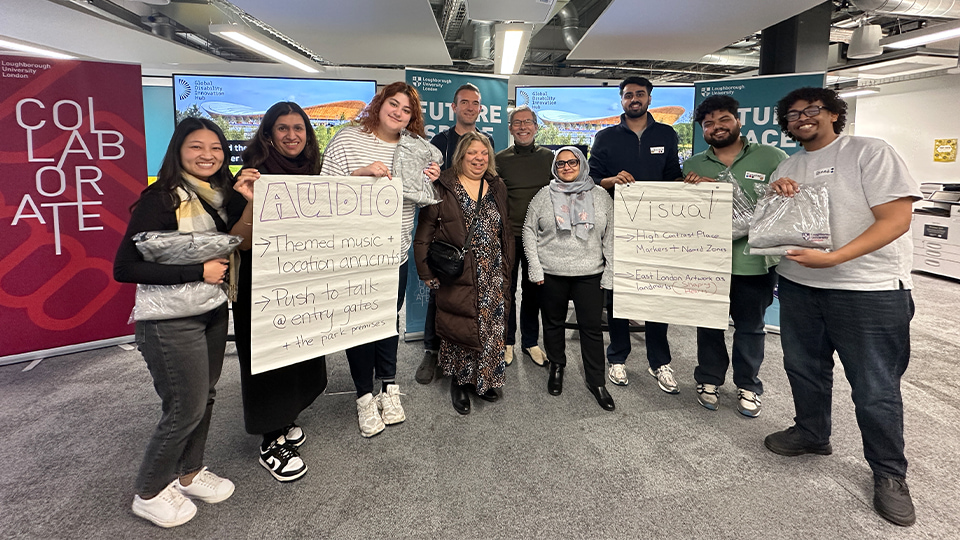
The Sprint was designed to boost students’ skills and confidence with teamwork, problem-solving mindset and provide tools that aid innovation and creativity. It was also a chance for students to meet each other and take on a fun challenge.
The Global Disability Innovation Hub set a challenge, to propose an innovation to support blind and partially sighted people’s placemaking and community. Three members of the local community joined as lived experience experts, Ashrafia Choudhury, Andrew Lamont, and Sameena Karim (Sam), sharing their experience of the park and challenges in accessibility. Maryam Bandukda (Research Fellow, GDI Hub) and Ben Hardman (Head of Innovation, GDI Hub) set the challenge and were on hand to support teams with their ideas.
Ben Cole, Head of Loughborough’s Future Space, shared:
Accessible design makes the world better for everyone. It was great to have GDI Hub here with our local experts to share a real-world challenge. We want our students to look at the world with curiosity and plot new ways of doing things. Taking them through challenges such as this is invaluable to their development.
Paulina Nguyen a student in the winning team, added:
The sprint was a great challenge to start my experience at Loughborough. I met fellow students from across the campus, took on a challenge and helped pitch our solution – I learnt a lot and had so much fun.
London 2012 created a powerful legacy, and as new students and community members are welcomed, maintaining that legacy matters. The Sprint is part of Future Space’s unique programme that seeks to build teamworking, problem solving and creativity in Loughborough’s students. The Future Space team has worked with organisations as diverse as IBM, Ford and Holland and Barrett on challenges around improving opportunities, access and sustainability. If you have a challenge or problem, you would like to propose please contact futurespace@lboro.ac.uk.
Loughborough University London is a founding partner of the Global Disability Innovation Hub. Over the past 10 years, we’ve worked closely together to develop a shared master’s programme (MSc Disability, Design and Innovation), deliver joint research, align on global initiatives, and collaborate on key issues.